
99% of PFAS — removed. Independently lab-tested.
Forever chemicals have been detected in drinking water across every Australian state. The Tappwater Countertop RO physically blocks them at the membrane — across five tested PFAS compounds. Sits on your bench, dispenses water from room temp to 95°C, replaces your kettle. No plumber required.
PFAS: forever chemicals that don't break down.
Per- and polyfluoroalkyl substances. Engineered since the 1950s for non-stick cookware, water-resistant fabrics, food packaging, and firefighting foam. The carbon-fluorine bond — the strongest in organic chemistry — is exactly what makes PFAS useful, and exactly what makes them refuse to leave.
Found everywhere
Detected in drinking water across every Australian state and territory. NSW, Victoria and Queensland have confirmed contamination sites linked to firefighting-foam use at airports and defence sites.
They bioaccumulate
PFAS don't pass through your body — they build up. Detected in the blood of over 98% of Americans (CDC) and almost certainly the same in Australia. Half-life in the human body: years to decades.
Linked to serious harm
Cancer (kidney, testicular), immune-system suppression, hormone disruption, thyroid disease, developmental harm in children, elevated cholesterol, liver damage. Research is still catching up.
Most home water filters can't remove PFAS.
PFAS molecules are physically small and chemically stable. Adsorption-based filters (carbon, ion exchange) catch some compounds but miss most. Only physical exclusion at the membrane level — reverse osmosis — gets you to lab-confirmed 99% reduction.
The most common filter type — pitchers, basic jug filters, faucet attachments. Effective for chlorine and basic sediment, but PFAS compounds pass straight through. Don't trust marketing claims here; check independent test data.
Carbon block filters (like Tappwater's EcoPro) achieve much better adsorption thanks to denser pore structure. Independently lab-tested at 93% PFAS removal across five compounds — exceptional for a tap filter. Still not RO-level, but the strongest carbon-based result we know of.
The membrane has pores 0.0001 microns wide. PFAS molecules — even the smallest — are physically larger than that. They can't pass through. The only consumer technology that gets you here without a $5,000 plumber install.
Five compounds. Independently tested. Published.
Tested by Laboratorio Echevarne, Barcelona — an ISO-accredited European clinical and environmental lab. Water was spiked at concentrations well above typical Australian tap-water levels (a standard stress-test protocol), then passed through the RO system and re-measured.
| PFAS compound | Common source | Removal |
|---|---|---|
| PFOA (Perfluorooctanoic acid) | Non-stick cookware, food packaging | >99% |
| PFOS (Perfluorooctanesulfonic acid) | Firefighting foam, stain repellents | >99% |
| PFHxS (Perfluorohexanesulfonic acid) | Firefighting foam, fabric coatings | >99% |
| PFNA (Perfluorononanoic acid) | Industrial surfactants | >99% |
| PFBS (Perfluorobutanesulfonic acid) | PFOS replacement chemical | >99% |
Physical exclusion. Not adsorption.
Reverse osmosis doesn't try to chemically bind PFAS. It physically blocks them. Water is pushed through a semipermeable membrane with pores 0.0001 microns wide — smaller than any PFAS compound. PFAS molecules can't fit through; they're flushed into the concentrate tank. Clean water passes; contaminants don't.
Everything above the green bar is physically too big to pass through the membrane. Including every PFAS compound ever identified.
Hot water in 60 seconds. Six temperatures. One press.
The RO Countertop doesn't just remove PFAS — it dispenses purified water at six exact temperatures, from room temp to near-boiling. It replaces your kettle, your jug filter, and your bottled water. One appliance does the job of three.
No waiting for the kettle to boil. No descaling. No filling, no spilling. And because you're replacing a kettle for your tea and coffee, you're not adding to your electricity bill — you're moving it from one appliance to another.
Shop the Countertop RO →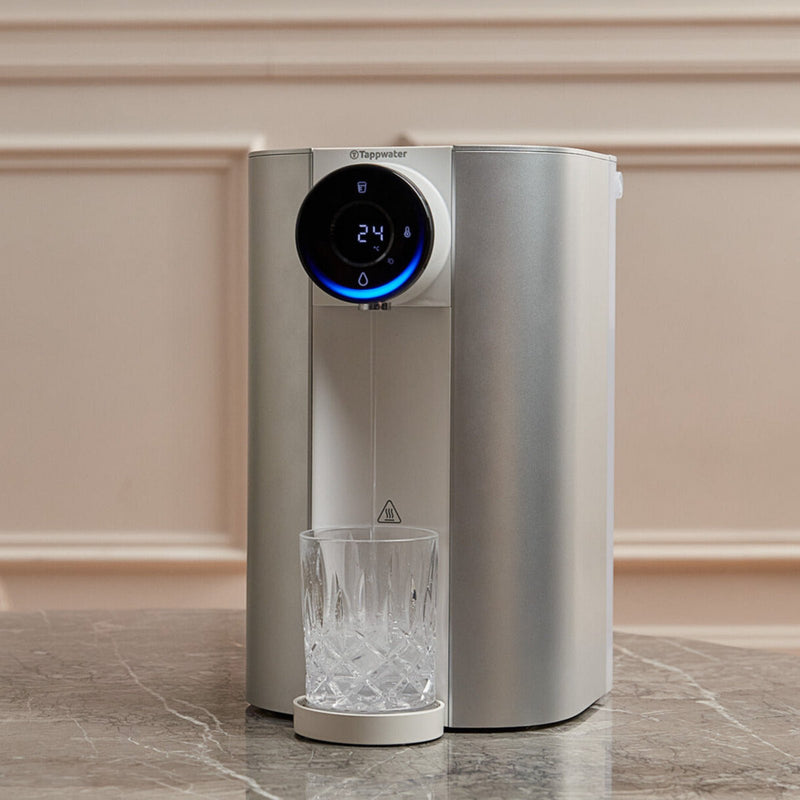
The Tappwater Countertop RO.
7-stage reverse osmosis. Sits on your benchtop. Plugs into a power point. No plumber, no drilling, no landlord conversation. 6 temperature presets up to 95°C — replaces your kettle too.
- 99% PFAS removal across 5 compounds, lab tested
- >99% fluoride · 100% lead, mercury & bacteria
- Swedish Mineral Rock™ adds calcium, magnesium & potassium back
- Zero installation · take it with you when you move
- 60-day money-back trial · 2-year warranty · free shipping
The EcoPro Compact reaches 93% on PFAS — and it sits on your tap.
A 5-stage activated carbon block tap filter. Not RO-level — but at 93% PFAS reduction across the same 5 compounds, it's one of the strongest carbon-based results we know of. For renters who want immediate PFAS reduction without committing to a benchtop appliance.

PFAS, answered.
Is PFAS really in Australian tap water?
Yes. PFAS contamination has been confirmed in drinking water near Defence sites (Williamtown NSW, Oakey QLD, RAAF Tindal NT, RAAF Pearce WA), airports, and industrial sites. Concentrations vary by suburb. Even where local water tests under regulatory limits, you may still be exposed via food packaging, cookware, and bottled water. PFAS bioaccumulates — small exposures over time add up.
Will a Brita jug or basic carbon filter remove PFAS?
No — not meaningfully. Granular activated carbon filters (which is what Brita-style jugs use) achieve roughly 0–30% PFAS reduction at best, and many compounds pass through almost untouched. Dense carbon block filters do better — the Tappwater EcoPro Compact reaches 93%, which is unusually strong for a tap-mounted filter — but the only home technology that hits 99% across all PFAS compounds is reverse osmosis.
How is "99% removal" actually measured?
Laboratorio Echevarne spiked influent water with each PFAS compound at concentrations well above typical AU regulatory limits — a standard stress-test approach. They then passed the water through the RO system and measured the effluent using LC-MS/MS (the gold-standard analytical method for PFAS quantification). The result was >99% reduction across all five compounds. Full report available on request or via our lab results page.
Does the RO unit need plumbing or installation?
No. It's a benchtop appliance — about the size of a coffee machine. Plugs into a standard power point. You fill the rear tank from your tap; the system does the rest. No connection to plumbing, no drilling, no landlord approval. If you move, you take it with you.
What else does it remove besides PFAS?
Fluoride (>99%), microplastics (>99.9%), lead and mercury (100% — undetectable after filtration), chlorine (>99.9%), bacteria including E. coli (100%), pesticides, pharmaceutical traces, and dozens of other contaminants. The RO membrane is non-selective: anything physically larger than 0.0001 microns is blocked. Then Stage 7 — Swedish Mineral Rock™ — adds calcium, magnesium and potassium back so the water isn't flat-distilled-tasting.
What does it cost to run, per year?
$199.99/year for the annual filter cartridge — about $0.55/day, or the price of one bottled water per week. The unit itself runs at a 3:1 ratio (3L clean : 1L concentrate), which is more efficient than most RO systems. Power use is about the same as a kettle when heating — minimal otherwise.
Stop guessing what's in your water.
Lab-verified 99% PFAS removal. Plus fluoride, microplastics, lead, bacteria. Plug it in and pour.
Shop the Countertop RO — $799.99 →60-day money-back guarantee · 2-year warranty · Free shipping Australia-wide